An ice rink safety barrier—the dasher board—is the first line of protection between athletes, officials, and spectators. Its material behavior under repeated impact and sustained sub-zero exposure directly determines injury risk and long-term operating cost. For rink owners, facility managers, and project contractors, choosing the right HDPE (high-density polyethylene) dasher board manufacturer is a material-science decision as much as a procurement one. Hebei Peliou New Materials Technology Co., Ltd. brings focused HDPE engineering expertise to this application. This article outlines what buyers should evaluate before committing to a supplier.
Low-Temperature Toughness Is the First Filter
Ice rink environments stay below freezing for extended periods, and some facilities operate in unheated or semi-outdoor structures where temperatures drop further. HDPE’s linear molecular chain structure gives it toughness that far exceeds PVC or wood-based alternatives. Commercial HDPE rink barrier specifications place the brittle temperature as low as −70 °C, with stable performance across a −40 °C to +70 °C service window—sufficient for both cold-climate outdoor rinks and humid indoor facilities. In practical terms, the board face resists cracking when struck by a puck traveling at match speed or by a player checking into the wall. The selection implication is clear: buyers should not accept a generic polyolefin sheet marketed as “HDPE” without documented low-temperature impact data. Peliou’s HDPE sheet line is positioned around these cold-service fundamentals, with HDPE already established in the company’s portfolio alongside synthetic ice rink systems.
Impact Energy Absorption: Look at the Numbers, Not the Thickness
A dasher board must absorb energy from puck impacts and body checks without permanent deformation. HDPE rink barrier data in the market cites notched impact strength (Charpy) of ≥100 kJ/m² and standard impact strength ≥140 kJ/m² in some commercial specifications. HDPE’s impact strength is frequently described as more than three times that of ordinary plastics, with the ability to withstand puck speeds around 150 km/h and to buffer player collisions without cracking or deformation under 5 kJ/m² impact loads. These figures matter because a thicker low-grade board can underperform a thinner, properly specified HDPE board under repeated cold impact. Peliou’s customization model allows the HDPE face thickness—10 mm is a common facing specification in published Peliou rink board references, with other thicknesses available on request—to be matched to the venue’s impact severity and budget.
Structural Integration and Custom Fit Matter as Much as the Sheet
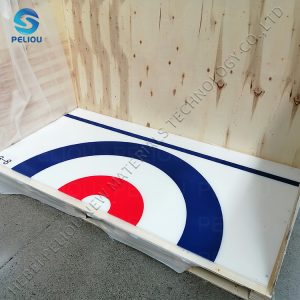
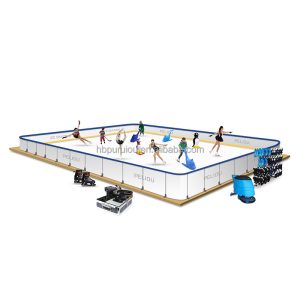
An HDPE face performs only as well as the frame and fastening system behind it. Rink geometry varies: corner radii, gate positions, glass heights, and advertising integrations all differ. A manufacturer that treats the board as a material-only commodity leaves the buyer to solve integration problems alone. The appropriate selection approach is to look for modular panel systems with customizable heights, curved sections, door placements, and transparent shielding configurations. HDPE dasher systems in the market typically pair the polymer face with galvanized steel or aluminum framing, using internal steel reinforcement and ground anchoring at regular intervals. Peliou’s production model is built around size and color customization and ODM/OEM capability, meaning the HDPE barrier can be developed from rink drawings or sample specifications rather than ordered from a fixed stock list. The published Peliou rink board range includes 1000 × 2000 mm and 1200 × 2000 mm formats with white HDPE facing, providing a starting point for project-specific adaptation.
HDPE Versus UHMWPE: A Rational Specification Decision
A frequent buyer question is whether HDPE or UHMWPE is “correct” for a dasher board. Both are polyethylene, but they serve different points on the cost–performance curve. Published comparisons place HDPE service life at roughly 5–8 years and UHMWPE at 10–15 years in rink barrier applications, with UHMWPE offering higher impact strength and wear resistance at a higher material cost. HDPE remains the material of choice for many puck-board and dasher-board applications because of its high impact strength, durability, smooth finish, moisture resistance, and low maintenance requirements—particularly where the venue’s duty cycle does not justify the premium of UHMWPE. A credible manufacturer should help the buyer make this trade-off explicitly, rather than steering every project toward the highest-cost resin. Peliou’s position as an engineering plastics manufacturer with both HDPE sheet and synthetic ice rink capability allows this conversation to be grounded in the actual operating profile of the rink.
Certifications and Traceable Quality Documentation
For public facilities, schools, and commercial venues, material consistency is not optional. Buyers should request documentation covering raw material grade, density range (HDPE typically 0.92–0.98 g/cm³), impact test data, and relevant quality-system certification. Peliou’s company profile references ISO quality-system instruments and testing standards, including ISO 868 for Shore hardness and ISO 527 for tensile properties, providing a documented quality framework that supports project-level material traceability. A supplier that can produce batch-level test reports and third-party verification is materially less risky than one that cannot.
Field Observations: Where an HDPE Barrier Proves Its Value
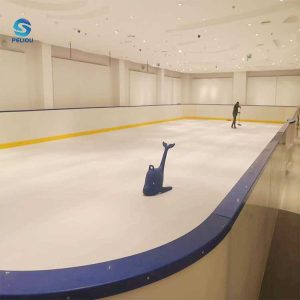
In operating rinks, the value of a well-selected HDPE barrier shows up in three patterns. First, lower life-cycle cost: the impact and abrasion resistance reduce face repairs, and the corrosion-free polymer surface eliminates the rust and repainting cycles associated with metal or wood barriers; routine cleaning can be as simple as rinsing with water. Second, consistent playability: HDPE’s low-friction, smooth face supports predictable puck rebound, and the low moisture absorption (≤0.01% in published HDPE barrier specifications) prevents swelling or warping in humid rink air. Third, design integration without performance trade-offs: colors, branding, kick plates, and handrails can be specified into the HDPE system—common configurations include white facing panels with blue cap rails and yellow kicker boards—while maintaining the board’s structural role.
Why Hebei Peliou New Materials Technology Co., Ltd.
Peliou operates as a dedicated engineering plastics manufacturer with HDPE sheet production, synthetic ice rink systems, and ODM/OEM customization within its core portfolio. For ice rink safety barrier projects, this means the buyer is not forcing a generic plastic panel into a demanding cold-impact application. Peliou’s production flexibility—size, color, and material formulation customization—allows the HDPE dasher board to be developed around the rink’s geometry, duty cycle, and visual requirements. The company welcomes project inquiries based on rink drawings, performance targets, or sample specifications.
Conclusion
Selecting an HDPE ice rink safety barrier manufacturer comes down to four questions: does the material retain documented toughness in the cold, does the impact data support the venue’s duty cycle, can the supplier deliver a fitted system rather than only a sheet, and is the quality traceable? Hebei Peliou New Materials Technology Co., Ltd. addresses these questions with HDPE material expertise and a customization-oriented production model. Rink projects that begin with a material-first, data-backed conversation tend to end with safer athletes, lower maintenance costs, and barriers that perform season after season.
 Peliou

HelloPlease log in